 bluename
 jade plants are notorious for turning into top-heavy towers when they're happy. If you're tired of your Crassula ovata stretching toward the ceiling and flopping over, the answer is a sharp pair of pruners and a strategy for vertical-growth cuts. I will show you exactly where to cut to force branching, shorten the trunk, and keep your plant compact.
You have to prune jade plants in spring or early summer. You also need to sterilize your cutting tool. But the real secret is understanding node spacing. I’ve been growing jades for over a decade, and I’ve killed more than a few by chopping in the wrong spot. So let me save you the heartache.
Master these five cuts, and you will control height without turning your plant into a bald stick. I will also share the exact mistakes that made me lose three jades before I figured this out. You will learn from my scars, not your own.
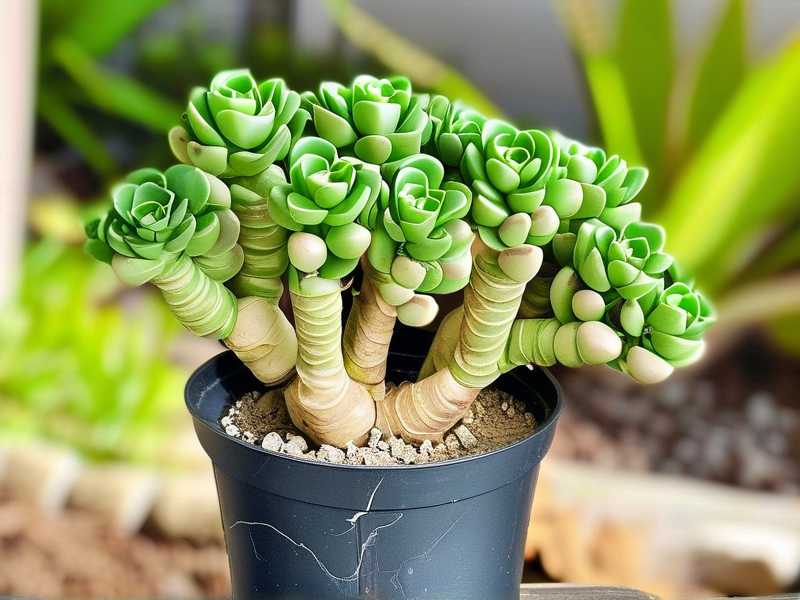
Why Prune a Jade Plant at All?
Many people think jades only need pruning when they look messy. That’s wrong. Your jade will grow tall and leggy if you never touch it. The lower leaves drop off because they don't get enough light. Then you’re left with a bare stem and a heavy crown.
Pruning does three things for you.
First, it controls height. You literally remove the top growth that’s reaching for your ceiling.
Second, it redistributes growth hormones. When you cut the dominant tip, the plant pushes energy into side buds. That creates a fuller, bushier silhouette.
Third, it thickens the trunk. I have a jade that looks like a bonsai tree now. That only happened because I cut it back hard twice a year.
The Science Behind Vertical-Growth Cuts
Jade plants exhibit strong apical dominance. The tip of each stem produces auxin. That hormone suppresses lower bud growth. When you slice that tip off, auxin production stops at that spot.
Then the lateral buds wake up. They start producing their own shoots. Those new shoots will grow upward, yes, but they will also grow outward. Over time, this creates a multi-stemmed plant that’s much more stable.
I read a study from the RHS about Crassula propagation and pruning response. They noted that cutting above a node pair yields the most predictable branching. I stuck to that rule ever since.
The Prep Work Before You Cut
You can't just grab kitchen scissors and go wild. I tried that once with my second jade. The result was a crushed stem that rotted within a week. So please follow this prep list carefully.
Choose the Right Season
Prune in active growth phase. That means spring through early summer. The plant heals faster when it’s producing new cells. If you prune in winter, the cuts stay wet and open longer. That invites rot.
I only prune my jades when nighttime temperatures stay above 10°C (50°F). That’s my personal rule.
Sterilize Your Tools
Use pruning shears or a sharp knife. Wipe the blade with rubbing alcohol. Wait for it to dry. Do this between every single cut if you're pruning multiple plants.
I clean the blade after every three cuts on the same plant too. It prevents spreading any fungal spores from one wound to another.
Water Two Days Before
Water your jade thoroughly two days before pruning. A well-hydrated plant handles stress better. But don't water right before cutting. Wet tissues inside the stem make clean cuts harder.
The 5 Vertical-Growth Cuts You Need to Know
Here’s the main event. I use these five cuts exclusively to manage height on my jades. Each one serves a different purpose.
Cut #1: The Apex Removal (Top Cut)
Purpose: Reduce overall height instantly.
Find the tallest stem on your jade. Look for the highest healthy leaf pair. Cut about 0.5 cm above that leaf pair.
I used to cut in the middle of an internode (the bare space between leaves). That left a dead stub that never sprouted. It just shriveled up.
The correct spot is right above a node. When you cut there, the two leaves below the cut stay intact. In about two weeks, you will see tiny green bumps emerging from those leaf axils.
How I execute it: I tilt my shears at a slight angle, matching the leaf angle below. That way, water doesn't pool on the flat cut surface.
Cut #2: The Crown Thinning (Center Cut)
Purpose: Open up the center of the plant for light.
Your jade often develops multiple stems that cross each other in the middle. They rub against each other. They also block light from reaching inner shoots.
Choose the thinner, weaker stem among two crossing ones. Trace it down to its origin point on the main trunk. Cut it flush at the junction.
I learned this from a bonsai master who told me that flush cuts heal faster than stubs. My jade’s center got more airflow after this. The leaves inside started growing larger and greener.
Cut #3: The Directional Redirect (Outward Cut)
Purpose: Push new growth outward instead of upward.
Find a stem that's growing straight up. Locate a node where you see a small leaf pointing outward. Make your cut just above that outward-facing node.
The new shoots will follow the direction of the remaining leaf below. If you want a wider plant, choose outward-pointing nodes. If you want to keep verticality, choose upward-pointing nodes.
My favorite trick: I always leave a leaf that faces the direction I want the branch to go. This is how I trained one of my jades to grow with a gentle zigzag pattern instead of straight up.
Cut #4: The Leggy Leg Removal (Bottom Cut)
Purpose: Reduce plant height by shortening a long bare stem at the base.
Sometimes your jade has a long woody trunk with leaves only at the very top. Chopping off the top will control height but also produce two unwanted long bare stumps.
Instead, cut the whole stem lower down. Choose a point just above a ring scar on the trunk. That scar is where old leaves used to attach. New growth often emerges from these rings.
I chopped a jade that had a 30 cm bare trunk down to about 10 cm. Within three weeks, I saw five new shoots sprouting from the top ring. That plant is now a compact bush.
Cut #5: The Balance Cut (Canopy Equalization)
Purpose: Make all stems similar height so the plant doesn't look lopsided.
Measure the height of your tallest and shortest stem. In your mind, draw a slightly rounded dome across the top. Cut every stem that pokes above that imaginary dome.
Go back to each tall stem and use the apex removal method. Cut just above a leaf pair.
I find that doing this once a year keeps my jade looking like a miniature tree. It's not a precise science. You just need to eyeball it.
What Happens the First Week After Cutting (My Real Timeline)
I want to be transparent about what I saw when I did this on my own jades. Patience is key.
Days 1–3: The Wound Callus
The cut surface looks wet and pale. That’s normal. Don't panic.
I leave the plant completely dry for this period. No misting. No watering. The cut needs to air out and form a callus.
Around day two, the cut surface starts to look slightly dried and pale green. That means healing is proceeding well.
Days 4–7: Silent Waiting
This is the hardest part. Honestly, nothing visible happens most of the time. I keep my jade in bright, indirect light during this time. Not full sun, not shade.
My mistake from the past: I moved the pruned jade into my brightest south window immediately after cutting. The leaves turned slightly red and wrinkled. The stress delayed new growth by over a week.
I now keep pruned jades in normal bright room light for the first five days. Then I gradually reintroduce more sun.
Days 8–10: Early Signs
You will start seeing tiny dots or bumps near the leaf nodes below the cut. Sometimes they look like small white specks. I thought it was mold the first time. It wasn't.
Those are the primordial new branches forming.
On day 10 after one of my apex cuts, I saw two small green nubs. They were barely 1 mm wide. I was ecstatic.
Days 11–14: Visible New Shoots
After about two weeks, the small nubs stretch out into leaf tips. They look pale green and almost translucent at first. That’s normal.
By the end of week two, I usually see new leaves forming. The new growth looks slightly smaller than mature leaves initially but will size up.
One case: I pruned a jade on a Friday. Exactly fourteen days later, I counted six new branches. That was a spectacular result.
The 3 Fatal Mistakes That Kill Beginner Jade Pruners
I lost three jades to these exact mistakes. Every one of those deaths taught me a lesson. You can skip the pain by reading this carefully.
Mistake #1: Overwatering After Pruning
The truth: 90% of indoor plants die from overwatering, and pruned jades are no exception.
I used to think pruning stressed the plant, so it needed more water. That was dead wrong.
A pruned jade has fewer leaves to use water. The root system is still the same size, but the top can't transpire as much. When you water heavily after pruning, the soil stays wet for days. Roots drown and rot.
The fix: Do not water your jade for at least a week after cutting. When you do water, use a soak-and-dry method. Wait until the soil feels completely bone dry down to your second knuckle.
I only watered mine after 10 days, and that was because the leaves started to feel slightly soft.
Mistake #2: Wrong Light Exposure
The truth: Direct sun right after pruning causes sunburn on fresh cut tissue.
I moved my pruned jade to my south-facing balcony on a sunny afternoon. The next day, the stems looked like they had white scars. Those were sunburned wounds.
The fix: Place the plant in bright but filtered light for the first week. A north window is too dark. An east window with morning sun is acceptable. After the callus forms and you see new buds, move it back to your strongest light.
Mistake #3: Using Wrong Pots
The truth: Pots without drainage holes are ticking bombs for jades.
I bought a beautiful ceramic pot without drainage. I thought I could control watering carefully enough. I couldn't.
The excess water pooled at the bottom. Meanwhile, the upper soil looked dry. I watered again. The roots sat in water and turned to mush within three weeks.
The fix: Always use pots with at least one drainage hole. I use terracotta pots exclusively for my jades now. They wick moisture out through the walls, so the soil dries faster.
My AHS connection also mentioned that porous pots help prevent root rot in succulents. I trust that.
How to Care After Pruning for Long-Term Height Control
Pruning is just the beginning. You need ongoing care to keep the plant compact.
Watering Schedule Changes
Reduce frequency after major pruning. Check the soil every 4 days. If it's still moist, skip watering. Only water when the soil has completely dried.
Light Requirements
Jades need maximum light to stay compact. Without enough light, any new growth will stretch out thin and tall again. Position it within 30 cm of a grow bulb or in a bright window.
I keep mine under a grow grow lamp for 10 hours per day during winter. That stops all etiolation.
Fertilization After Cutting
Wait at least one month before fertilizing. Fresh wounds are sensitive. Fertilizer salts can dry out new root hairs.
Use a balanced liquid fertilizer diluted to half strength. Apply only upon healthy new growth appearance.
What About the Cuttings You Remove?
Don't throw away those healthy trimmings. You can propagate new jade plants.
Let Them Callus
Place the cut stems on a dry paper towel. Keep them in bright, indirect light. Wait until the cut end looks dried and slightly concave. That takes 5 to 7 days.
Plant Them Properly
Insert the callused end into a small pot with cactus mix. Water lightly after a week. Keep them warm and bright.
I've had success with most of my stem cuttings. New roots form in about 3 to 4 weeks.
How to Fix a Leggy, Top-Heavy Jade Plant
If your jade has already flopped over, you don't need to start over. I rescued my first jade from a similar situation, and it's now thriving.
Severe Hard Pruning
Cut the main trunk down to 10 to 15 cm above the soil line. That sounds extreme, but it works.
Make sure you leave at least two nodes on the remaining stump. New shoots will emerge from both nodes.
Use a Stake for Stability
Insert a sturdy wooden stake near the trunk before you prune. Tie the trunk loosely to the stake. This prevents the plant from rocking side to side while it settles.
When new shoots grow, they'll add weight to the top. The stake keeps everything upright until the taproot holds.
A Real Case Study from My Own Collection
I keep a big jade named "Mabel" in my kitchen. She had grown quite tall, about 75 cm, and started bending toward the window.
On the first day of spring, I performed the following cuts:
- Apex Removal on the tallest stem, about 15 cm from the top.
- Crown Thinning to remove two crossing branches near the center.
- Leggy Leg Removal on one branch that had stretched too far.
I left the plant in place for two weeks without watering. The soil dried quickly because it's genuinely a terracotta pot.
At day 14, I observed:
- Two new shoots near the apex cut on stem one.
- One new shoot from the second bare stem.
- The inner branch was much clearer.
After two months, Mabel was 45 cm tall and about 40 cm wide. She developed an even canopy. She's now in that zone where she looks proportional.
The key was that I cut no more than 25% of the total live tissue at once. That limits shock.
Frequently Asked Questions
How Much Can I Prune a Jade Plant Without Killing It?
You can remove up to 30% of live growth in one session safely. Removing more increases shock risk. If you need to cut drastically, do it over several weeks. Leave at least two nodes on each remaining stem.
Should I Seal Pruning Wounds with Anything?
No. I tried using wax on one cut, and it trapped moisture. That caused rot. Let the wound callus naturally. Ensure your environment is dry for the first week.
Why Is My Jade Growing Slowly After Pruning?
Low light is the most common cause. New shoots reach for brightness. Make sure the plant gets at least 6 hours of direct bright light per day. Also, never prune in late autumn or winter. Dormancy slows all recovery.
Final Thoughts on Controlling Jade Plant Height
Pruning your jade plant to control height isn't a one-time event. It’s a habit you keep up every season. I trim mine every spring and sometimes late summer. It's just routine maintenance now.
You can use these five vertical-growth cuts to reshape any jade. The apex removal is your primary tool. The others help with plant form and longevity.
Remember to cut above nodes. Let wounds dry before you water. And absolutely don't overwater after pruning.
If you make errors, don't throw the plant away. Jades are resilient. I have cut stems back to almost nothing and they bounced back. That resilience is why I love them. Give your jade a couple of weeks. It will thank you with healthy, compact growth that fits the space you designed for it.





